Waiting in Advent with James Hampton

Throne of the Third Heaven of the Nations' Millennium General Assembly, by James Hampton.
Folk art in the Smithsonian American Art Museum (National Portrait Gallery), Washington, DC, USA.
_____________________________________________________________________________________
The name of your drum group is Southern Moon. You joined a year after you started working at the Indian Center as a janitor. You're supposed to say custodian now, or maintenance person, but you've always thought of yourself as a janitor. When you were sixteen you went on a trip to Washington D.C., to visit your uncle - your mom's brother. He took you to the American Art Museum, where you discovered James Hampton. He was an artist, a Christian, a mystic, a janitor. James Hampton would end up meaning everything to you.
When I read this passage in Tommy Orange's novel There There, I switched my iPad to search mode and immediately put in the name of James Hampton. I wanted to know about this artist, this Christian, this mystic, this janitor.
I'll let Tommy Orange's character Thomas Frank - who refers to himself in the second person - tell you why James Hampton ended up meaning everything to him.
James was a Christian. You are not. But he was just crazy enough to make sense to you. This is what made sense: He spent fourteen years building a massive piece of artwork out of junk he collected in and around the garage he rented, which was about a mile from the White House. The piece was called The Throne of the Third Heaven of the Nations' Millennium General Assembly. James made the throne for Jesus' second coming. What you get about James Hampton is his almost desperate devotion to God. To the waiting for his God to come. He made a golden throne from junk.
Thomas Frank tells us of his own waiting for what he calls "the State," a condition that came to him sometimes when intoxicated, "where everything felt exactly, precisely in place, where and when it belonged, you belonged, completely okay in it...." Thomas is waiting for it all to come together, and he recognizes in James Hampton someone who was a companion in waiting. Someone who - through a different path from his own - found himself in "the State."
James Hampton had a job as janitor for the General Services Administration in Washington D.C. for his entire career. After work, frequently after midnight, he went to a rented space within a mile of the US Capitol to work on his magnum opus, which he called The Throne of the Third Heaven of the Nations' Millennium General Assembly. He found objects. He wrapped these objects in shining foil and arranged them in accordance to the visionary states that came upon him, making a throne for Jesus to occupy at his second coming. These ordinary objects became a glistening, complex, beautiful work of art in which the viewer finds can recognize symbols and characters from both the Hebrew Scriptures and the New Testament. A key textual reference behind his inspiration is inscribed on a small panel, and it is a reference to this passage from the Book of the Revelation to St. John the Divine, chapter 7:
After this I looked, and there was a great multitude that no one could count, from every nation, from all tribes and peoples and languages, standing before the throne and before the Lamb, robed in white, with palm branches in their hands. They cried out in a loud voice, saying, “Salvation belongs to our God who is seated on the throne, and to the Lamb!”

The title of Hampton's work indicates another key textual inspiration for Hampton from the Second Letter of Paul to the Corinthians:
I knew a man in Christ above fourteen years ago, (whether in the body, I cannot tell; or whether out of the body, I cannot tell: God knoweth;) such an one caught up to the third heaven. (2 Corinthians 12: 2-3, KJV)
Hampton - whose chosen title for himself was Director, Special Projects for the State of Eternity, was born in 1909 in Elloree, South Carolina, one of four children of a gospel singer and self-ordained Baptist minister who essentially abandoned the family to go touring. In 1928 Hampton moved to Washington D.C. to live with a brother, was drafted in 1942 into the US Army, and served in a segregated unit in Guam and Saipan maintaining airstrips. Returning to D.C. after the war, he took the janitor job with the GSA, remaining in that work until his death. Hampton never married, and had few close friends. A couple of photos I've seen of Hampton with his great work indicate that someone saw his work in progress, but the work was not generally known until after Hampton's death in 1964, when his landlord visited the rented workspace and called the attention of the art world to what was in there.
James Hampton, known to those who knew him as a janitor, is now recognized as a great artist. I once held the job of janitor while a college student, so I know that the work does give one solitude to think and, if inclined, to meditate and pray, or just to allow one's mind to wander. Tommy Orange's character Thomas Frank describes what being janitor was like for him.
I'm imagining James Hampton at work, a ring of keys at his belt, pushing his custodian's cart through quiet halls and office spaces after the workers had left for the bus or train or drive home. There were no transistor radios in those days, no iPods, no earbuds. He probably had long hours of silence in which the only sounds were the soft rumble of the wheels on the cart, the swish of a mop and the splash and trickle of the mop bucket, the soft whisper of the broom bristles on the floor, the clunking sounds of emptying wastebaskets. He had hours to think, to listen to the silence, to let the words Scripture roll around in his mind, perhaps to hum as he dusted a desktop or shelf. He had hours in which he could see his creation taking shape in his mind before he got back to his work studio to flesh out his visions using material objects.Anyway, being a janitor was just a job. It paid the rent, and you could have your earphones in all day. No one wants to talk to the guy cleaning up. The earphones are an additional service. People don't have to pretend to be interested in you because they feel bad that you're taking their trash out from under their desk and giving them a fresh bag.
James Hampton became a mystic in those many quiet hours, for it is in silence that that distractions lose their hold on us, and the vastness and depth of the mystery of our being begin to rise to the level of our consciousness. I imagine during those quiet hours lifted from his mundane tasks to contemplate sublime, heavenly, eternal things.
The seer of the Book of the Revelation has a vision into heaven where the throne of God is, and Paul the apostle, in a most mysterious aside, writes of knowing someone who had gone there. What was that about? And was James Hampton also taken up there? This is a mystery to be contemplated, not solved.
The throne of God, however, is not meant to remain in heaven. After all, in another passage from the Apocalypse John the Divine writes:
And I saw the holy city, the new Jerusalem, coming down out of heaven from God, prepared as a bride adorned for her husband. And I heard a loud voice from the throne saying, “See, the home of God is among mortals. He will dwell with them as their God; they will be his peoples, and God himself will be with them; he will wipe every tear from their eyes. Death will be no more; mourning and crying and pain will be no more, for the first things have passed away.” And the one who was seated on the throne said, “See, I am making all things new.” (NRSV)So there was James Hampton, stowing away the implements of his janitorial work at the end of his shift, closing the door behind him and departing in the dark of night for his workspace not far from the White House to prepare a throne for God to sit upon at the return of the Christ of God.
James Hampton must have longed for deliverance from the power of evil. I see personified in him the longing of which the Apostle Paul wrote in his Letter to the Romans:
For we know that the whole creation groaneth and travaileth in pain together until now.
And not only they, but ourselves also, which have the firstfruits of the Spirit, even we ourselves groan within ourselves, waiting for the adoption, to wit, the redemption of our body. (Romans 8:22-23 KJV)
James Hampton must have pondered the presence of evil among us; an evil he had known in war time in the Pacific Theatre, and an evil he must have known from childhood, having been born and raised in a segregated world in a small southern village populated by sharecroppers and tenant farmers. All during his life he would have been negotiating the challenges that all black people had to face in a white-supremacist society in which black people were second-class. It's hard to imagine that James Hampton did not know personally people who had once been bought and sold like cattle; people who had built the wealth of the nation and shared none of the benefits. He knew Jim Crow. He knew the scorn of fellow Christians, the demeaning reality of segregation. James Hampton must have pondered the Scriptures which speak of a future fulfillment of God's purposes and longed to see that day. In anticipation of that day, he built a throne for Christ.
This is all deeply touching to me. I find myself imagining what it might have been like to have the privilege of sitting near James Hampton in that garage workspace, listening to him and asking him questions.
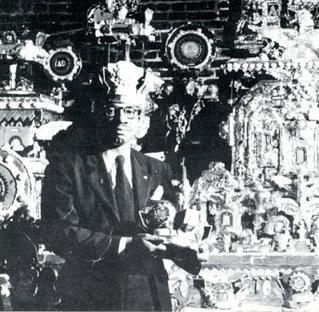
There is a photo of James Hampton wearing one of the crowns he created for this work. I'm reminded by this of the passage in the Apocalypse - a work addressed to believers in a time of persecution by Rome -which reads:
...And hast made us unto our God kings and priests: and we shall reign on the earth.
The photo of a crowned James Hampton reminds me that the meek shall inherit the earth. Not those with a lust for power, not those of us who deem ourselves superior by our wealth or position or rank or clerical caste or gender or race or creed or nationality, but the meek. This Jesus taught us.
Finally, over the top of his great work James Hampton posted a sign in block lettering. It read:
FEAR NOT
I bless God for James Hampton and for his witness this Advent, and I wait with him for the Second Advent.


Comments
Post a Comment